
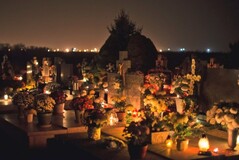
 The Christian tradition in Central and Eastern Europe is to ring the church bells at dusk on All Souls’ Eve. Families go to cemeteries bringing bright yellow and orange chrysanthemums and lighting yellow, or orange votive candles to decorate the graves of their beloved departed. Liturgical services are held at the cemetery or at the local church. Families make cookies or pastries to take to the church services to share with the other attendees. According to Eastern Orthodox tradition, the souls of the departed come back on this day and stand at their own gravesites or outside their homes. For this reason, relatives set chairs and food near the home fireplace and set sweets on the hearth. Family members also light candles or lanterns to illuminate the departed’s road to help them find their way back to the Light of Heaven.
All Souls Day also reminds us of our own mortality. For most of us, the night is a time for sleeping. Sleep is a funny thing. On the one hand, it is a functional process. In sleep we process the day’s events, ordering and collating the day’s data. On the other hand, sleep is the “little death”, a rehearsal for that last journey into the great mystery. I was thinking about this as I went to bed last night and lay there in the dark, hoping my thoughts wouldn’t keep me awake. While we sleep, others are at work, and nocturnal creatures hunt and feed. The raccoons who live near our house, work hard to figure out how to get into our bird feeder again. The night is also the time of dreaming. Whether we remember our dreams or not, we usually spend two to three hours of the night dreaming. Spiritually, while we dream, or during those hypnagogic (half-asleep/half-awake) times, the veil between worlds is thin. According to the Book of Job, “In a dream, in a vision of the night, when deep sleep falls on people, as they slumber in their beds, God may speak in their ears” (33:15). Songwriters Paul Williams and Kenneth Ascher recognized this when they wrote the lyrics for their song, Rainbow Connection: “Have you been half asleep And have you heard voices? I’ve heard them calling my name… I’ve heard it too many times to ignore it: It’s something that I’m supposed to be.” Perhaps, after all, there isn’t that much difference between sleep and death. Sleep doesn’t frighten us because we trust that we will wake up in the morning, and life will continue as always. But what about death? I suspect that death is a lot like going to sleep and waking up in a new place with our relatives and ancestors who live there. In the Gospel of Thomas, the disciples ask Jesus, “When will the dead find their place again in unity with God, and when will the new world come? Jesus said to them, ‘What you look forward to has already come, but you do not recognize it” (Saying 51). I want to close with an excerpt from Holidays and Holy Nights by Christopher Hill: “Savor the word fall. At this time, we watch the fall of the reign of summer, a great triumph moves deep into a darkness full of danger, promise, and mystery. We pass through a wild night of apparitions into a quiet that grows deeper until it is infused with the lights of candles and stars. Time narrows down until it comes to its turning point, as all creation holds its breath in the silent night and waits for the entry of something new and unimaginable.” May The Holy One open our eyes, so that we may recognize that death, is an entry into something new and unimaginable in our place in Sacred Unity. Early this morning, as I looked out my home office window, I could see that big ball of fire we call the Sun just clearing the trees toward the East. I started to think about how the Holy One appears again and again in Biblical stories as fire. In the Book of Exodus, Moses encounters the Holy One in a burning bush. In the Acts of the Apostles, the Holy Spirit appears as a flame that divides and comes to rest above the heads of the disciples. These are the two most familiar examples, but there are many other stories of the Divine appearing as fire in the Hebrew Scriptures and in the scriptures of other religions.
Recording one of her visions, the twelfth-century saint and mystic, Hildegard of Bingen, wrote down what she heard: “I, the Highest and Fiery Power, have kindled every spark of life. I, the fiery life of Divine Essence, am aflame beyond the beauty of the meadows, I gleam in the waters, and I burn in the sun, moon, and stars… I remain hidden in every kind of reality as a fiery power” (Vision 1.2). The poet Elizabeth Barrett Browning had a similar revelation which she shared in her epic poem, Aurora Leigh: “Earth's crammed with heaven, and every common bush afire with God: But only he who sees takes off his shoes.” This “fire” is also a part of us. In The Book of Proverbs, it is written that “The soul of the human being is the flame of God” (20:27). Helen Keller recognized this. Perhaps she was more attuned to her inner senses because her outer senses of seeing and hearing were absent. She wrote in her book My Religion, “I feel the flame of eternity in my soul.” I find it fascinating that this same idea harmonizes across cultures and religions. In Chinese philosophy, Shen extends itself through all that exists. The word Shen can be translated in many ways such as “spirit”, “soul”, “God”, and “numinous”. Shen is associated with fire and resides in the heart. Saint Paul also tells us that God’s Spirit resides in our hearts, and advised the fledgling Christian community, “Never let the fire in your heart go out. Keep it alive” (Romans 12:11). So, what can we do to keep the divine flame alive in our hearts? One way is through meditation. If you are an early riser, I suggest facing the rising sun and beginning your meditation with a prayer. This one from the Celtic Christian tradition is one of my favorites: At the rising of Your sun Lord God, Creator of light, At the rising of Your sun each morning, let the greatest of all lights, Your love, rise, like the sun, within my heart. Then just sit or stand quietly and breathe into your belly. Let the sunlight remind you of the Divine light in your heart and ask this light to lead you throughout the day. Jesus said that we are to allow the light of this flame to shine forth. (Matthew 5:14-16), so send your light out to those who need healing in the world. My Quaker friend likes to say, “I will hold you in the Light.” End your meditation with a prayer. I like this one: May the light of God illuminate the heart of our souls. May the flame of Christ kindle in us, love. May the fire of the Spirit free us to live fully, this day and forever. Amen.
I grew up in the South and when someone was surprised by something they heard, they would often say, “As I live and breathe!” We are entering the season of Pentecost and it is the beginning of something surprising happening. On Pentecost Sunday we hear the story of the disciples of Jesus gathering together to celebrate Shavout, the Jewish festival of the giving of the law to Moses on Mount Sinai, when “Suddenly, there came from heaven a sound like a mighty rushing wind, and it filled the whole house where they were sitting” (Acts 2:2). In the Jewish Scriptures, the Hebrew word used for spirit is ruach. In the creation story, “The earth was chaos, darkness was on the surface of the deep, and the Ruach Elohim (Spirit of God) was hovering upon the surface of the water” (Genesis 1:2).
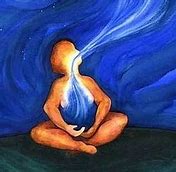
Besides spirit, ruach can mean wind, breath or life force. This gives us an image of the Spirit all around us and within us. In the creation story, it is this same Ruach Elohim that entered into the first humans and gave them life. We read, “And the Lord God formed the human and breathed into its nostrils the breath of life; and the human became a living soul.” We take for granted the miracle of breath that fills our lungs, and keeps our heart, mind, and entire body functioning from our first moment of life until our breath leaves us at our death. This more expansive image of spirit and breath is not limited to Judaism and Christianity. Indeed, it is found in traditions all over the world. According to Navajo tradition, the Winds first appeared from the horizons of the four cardinal directions, and these Winds come to each child at the moment of birth, giving life. Soon after their birth, Navajo babies are presented to the four Winds by their parents to give thanks, symbolically reminding them that the life and breath that sustains them is the same life and breath that is the Holy Wind energizing the entire cosmos. The people of New Zealand and Hawaii, greet each other by touching foreheads and noses in a symbolic sharing of breath and life force they call ha. When Hawaiians greet each other saying aloha, they are sharing love, affection, peace, and the Spirit of Life that holds everything together. The ancient Celts used the word awen. This word is formed by combining the two words, aw, meaning fluid or flowing, and en, meaning essence, inspiration and spirit. So awen literally means flowing spirit. Awen was adopted by early Celtic Christians to describe the role of the Holy Spirit. Like the Navajo Holy Wind, Awen is Divine Energy that surrounds and fills us with every breath, inspiring our minds and souls. With each breath we take, we are breathing in the Spirit of God, the breath that has given life across the ages on this earth. How much richer our lives might be if only we were conscious of our breathing God in and out with each breath. This poem by Rumi invites us to experience this Spirit: Right now, feel the breeze from the spiritual north of the divine life. The air is becoming fresher, like the purity we face at dawn when the gentle wind blows. So let the breezes of the divine breath polish your heart. Every sadness will lift. In the pause where your breath stops, just for an instant, you may just dissolve into Holy Spirit.  Do you know the word for thanks in Spanish or Italian? In Spanish we say Gracias and Italian,‘Grazie for thanks. These are from the Latin gratias. Gratias is translated as “thanks” But it is really means “grace”
Grace is an infusion of divine holiness. So having gratitude - recognizes the holiness underlying everything for which we are grateful. All of these words: gratitude, grateful, gracias - teach us that everything is a gift, everything is holy! The creation story in the Jewish book of Genesis celebrates this original grace. The Creator says that all things, including us, are “very good”, that is - full of grace. Perhaps most universal among spiritual practices is bowing. In qigong, tai chi and aikido, we always begin and end with a bow. Bowing is a way of practicing gratitude, respect, appreciation and gratitude. In the Celtic Christian tradition, men tip their hats and bow and women curtsey to the rising sun and to the rising moon. Since COVID began and handshaking became more risky, I have begun to tip my hat or slightly bow to people. Maybe it’s because of my many years of Asian martial arts and qigong training. So I bow to you in thanksgiving. And maybe tonight, or tomorrow, you will bow in gratitude to the moon and sun as they rise and set as a reminder of the grace that surrounds us and infuses us with holiness.  When we are asleep and dreaming, we are unaware that we are dreaming, and whatever is happening in our dream seems very real. We do not realize or recognize that what is happening in our dream is a creation of our individual and collective unconscious, and therefore we are unable to change it. But occasionally, we experience what is called a lucid dream and are aware that we are indeed dreaming. When this happens, we are no longer inexorably trapped in whatever happens - we can change our dream - even break the laws of physics in our dream world. For example, we can fly or have magical powers.
What if our awake state is similar? What if there can be “lucid” times when we realize that there is more to what seems real than that which appears to our senses. What if the laws of physics are not fixed once we realize this? Is this what the Buddha meant when he said he was awake? Is this what the Celtic Christians meant when they taught that Jesus was the one who remembers and was here to teach us to remember? What if we are more than we can normally see, feel, and do in our awake world? In the gospel story of the transfiguration, Jesus’ disciples, Peter, James and John see Jesus “transfigured before them. His face shone like the sun, and his clothes became as white as the light” (Matt 17:2). The usual interpretation of this story is that Jesus was manifesting his divinity, but what if the story is really about Peter, James and John experiencing a moment of being “awake”? Jesus wasn’t the only person who was seen as radiating with light in sacred scriptures. When Moses returned from his encounter with the Holy One on Mount Horeb, the Jewish scriptures say: “His face shone brightly” (Exodus 34:29-30). But this is not just a phenomenon written about in religious scriptures. In the late 18th century, a Russian attorney, Nicholas Motovilov wrote about his encounter with Russian Orthodox priest and teacher Seraphim of Sarov as follows: “Fr. Seraphim was sitting across from me, teaching about the Holy Spirit. I asked him: ”Father, how can I know if the Spirit is with me or not?” The elder took me firmly by the shoulders and said, "We are both now, my dear fellow, in the Holy Spirit." It was as if my eyes had been opened, for I saw that the face of the priest was brighter than the sun. In my heart I felt joy and peace and in my body, a warmth, and a fragrance began to spread around us. But I was also terrified by the fact that his face shone like the sun.” So, it seems as though other holy people also can be seen as shining like the sun. But wait, there’s more, as the infomercials say. Motovilov continues his account: “So Holy Seraphim said to me, "Do not fear, dear fellow. You would not be able to see me this way if you yourself were not shining in the fullness of the Holy Spirit.” The monk and author Thomas Merton, wrote about an experience he had in the center of the shopping district in Louisville Kentucky. He reported that, “It was like waking from a dream of separateness into a special world. And if only everybody could realize this! But it cannot be explained. There is no way of telling people that they are all walking around shining like the sun.” We are ALL walking around shining like the sun. Who would have thought! There is a line in the beginning of John’s Gospel that usually gets overlooked. In fact, I’ve never heard a sermon preached about it. John wrote,“In him (referring to Jesus) was life, and that life was the light of all people” (John 1: 4-5). Again we hear, “The light of ALL people.” Even Yoda, in Star Wars, told Luke, “Luminous beings are we, not this crude matter.” Now biology agrees that we are luminous beings. Scientists have demonstrated that every cell in our body emits light. These light emissions, which are not only emitted by humans but by all living things, are called biophotons. Studies have also found that only living things emit light. You can learn more about this here: https://www.youtube.com/watch?v=BA5TYZ1g1zQ Why don’t we always see this light in ourselves or in others that the disciples, the Israelites, Motovilov, and Thomas Merton saw? From a purely scientific point of view, our eyes can’t usually see light in the spectrum in which these biophotons appear. But what if there is more to it from a spiritual or metaphysical view? What if it is because our waking life is like a dream and we are not lucid, or awake enough to see this light? After his enlightenment, it is said that the Buddha passed a man on the road who was struck by the Buddha’s extraordinary radiance and peaceful presence. The man stopped and asked, “Are you a celestial being or a god?' “No” said the Buddha. “Well, then, are you some kind of magician or wizard?” Again the Buddha answered, “No.” “Well, my friend, then what are you?” asked the man. The Buddha replied, “I am awake.” Perhaps St. Peter gives us a hint to this dilemma in one of his letters. He wrote, “Pay attention as to a light shining in a murky place, until the day dawns and the morning star rises in your hearts. Maybe Peter is referring to the divine light that is already in us but is hidden in our murky places - in our psychic pain - by the business and distractions of everyday life - in our collective forgetting. Maybe that is why Jesus said, “I have come into this world, that those who do not see may see” (John 9:39).  The realm of heaven is like a woman who left her car out in the sun with all the windows rolled up. When she returned to the car it was blistering hot inside. Everything in the car was too hot to touch. The air in the car was so hot that it was difficult to breathe and she began to sweat and was very uncomfortable. So immediately she rolled down all the windows and the cool breeze blew through the car. The air in the car immediately cooled down and it soon became easy to breathe. The air was no longer stale and hot. Instead is smelled of fresh mown grass and cooled her skin.
I cannot help but see the Holy Spirit as an archetype. Archetypes are universal themes existing in what C.G. Jung called the collective unconscious. They are cross cultural, transhistorical, transreligious, and appear over and over again as characters in myths, fairy tales and stories all over the world. This does not mean the Holy Spirit is not a real and living presence, but that the archetype of Holy Spirit or Spirit of God holds deeper meanings than that which appear in Biblical stories. The first time we hear about the Spirit of God in the Jewish Scriptures is in the creation story of Genesis: “Now the earth was formless and empty, darkness was over the surface of the deep, and the Spirit of God was hovering over the waters.” (Genesis 1:2) The Hebrew word for spirit is ruach, a feminine word meaning spirit, breath, wind, and life force. The word ruach, or its Greek equivalent, pneuma, appears over 800 times in the Bible. Jesus used this word, when he said, “The wind (ruach) blows where it wishes and you hear its sound, but you do not know where it comes from or where it goes. So it is with everyone born of the spirit.”(John 3:8) It was the ruach ha-kodesh (holy spirit) that blew like a mighty wind in the Pentecost story. According to the Navajo tradition, Wind appeared from the horizons of the four cardinal directions. Wind comes to each individual at the moment of birth and gives the child the vital breath of life. This archetypal idea is also expressed in the Jewish creation story: “And the Lord God formed the human . . . and breathed into its nostrils the breath of life; and the human became a living soul.” (Genesis 2:7) Soon after their birth, Navajo babies are ceremoniously presented to the winds who reside in the north, south, east, and west, who give them a "little wind" which reminds them that the life and breath that sustains them is the same life and breath that that the wind that dwells within them is entwined with the Holy Wind that encompasses the cosmos. In China, this wind or life breath is called qi. According to Zhuangzi, when a human is born, qi is gathered. When qi is gathered, life thrives. When qi is dispersed, life ends. The Breath of God, the Navajo Holy Wind, Qi, surrounds and fills us with every breath we take. For us humans, wind, and breath, and spirit are meteorological, biological, and theological. The story tellers of Genesis understood something that the yogis, Taoist sages, and Navaho have also been teaching since ancient times: that there is a difference between the air we breathe and the life giving principle contained within it. This inner breath also called qi, prana, holy wind, or energy runs through our body, mind and soul. In his Book of Secrets, Indian mystic Rajneesh Osho writes: “If you can do something with breath, you will attain the source of life. If you can do something with breath, you can transcend time and space. If you can do something with breath, you will be in the world and also beyond it. There are certain points in the breathing which you have never observed, and those points are the doors, the nearest doors to you, from where you can enter into a different world, into a different being, a different consciousness.” When you go outside and feel the wind blow on your face, that is the Divine Wind reaching out to cool you, to touch you. How different our lives might be if we were conscious that we breathe in holy breath, that we share in the breath of one another, of trees and of animals, of all the people who have lived and that we are born of the Eternal Wind. Wake up, you who are sleeping! Rise from death, and Christ will shine on you. ~ Ephesians 5:144/4/2021  It is Easter morning and we gathered via Zoom to celebrate the resurrection of Jesus - a cornerstone of the Christian faith.
But did you know that there are similar stories of death and resurrection in cultures all over the world? There is a Sumarian story of the goddess Inanna, the Egyptian story of Osiris, Asclepius and Achilles are raised from the dead in Greek mythology, Baldr is raised from Hel in the Norse myth, and there are other resurrection myths throughout the world. Even fairy tales include this theme. Snow White is returned from a “sleeping death”, and in J.R.R. Tolkien’s Lord of the Rings, the Wizard Gandalf the Grey is resurrected as Gandalf the White. Since these stories appear in so many forms and places, one has to ask, “What is this story trying to tell us?” Jewish tradition teaches that it is always important to find ourselves in Biblical stories, so, where do we find ourselves in the story of the Resurrection? I believe that people did see or encounter Jesus in some way after his death and burial, but those who encountered him, experienced him in a very different way. Jesus had been transformed. According to the gospel stories, Jesus could pass through locked doors. He appeared and disappeared at will. Some people didn’t recognize him, not even his closest companion, Mary Magdalene until he allowed it. Somehow Jesus was transformed. But Easter is not just about Jesus, it is about each one of us dying in some metaphorical manner and being transformed - awakened. Maybe it’s about dying to what the Celtic Christians teachers called our false self and awakening our True Self. By false self, I don’t mean bad self. The False Self is more like the self that we show to others, and to ourself. It is what Carl Jung called our persona. The False Self looks at things with the ego as its reference point and changes to meet the various situations in our life. The True Self is the part of you that sees truthfully through divine eyes, the you and the me that is made in the image of God. The false self needs to metaphorically die for the True Self to be awakened and rise up. Carl Jung would agree with this idea. He wrote: “What happened in the life of Christ happens always and everywhere. The Risen Christ represents the final perspective of every True Self.” Jesus’ disciple, John the Beloved, wrote in a letter to his followers, referring to Christ: “My dear people, we are already the children of God. But what we are in the future is not yet fully revealed. All we know, is that we shall all be like him” (1 John 3:2). But this is not an easy task. Jung also wrote, “One does not become enlightened by imagining figures of light, but by making the darkness conscious. The latter procedure, however, is disagreeable and therefore not popular.” As in many of the resurrection myths, we must go into hell before we can rise to new life. Ninth century Celtic Christian teacher, John Scotus Eriugena, taught that we suffer from the “soul’s forgetfulness,” and that Christ came to reawaken us to our true nature or True Self. He came to show us the face of God and he comes now to show us our own true face. But our True Face or Self is well hidden behind the mask of our false self. In the 1991 movie Hook, with Robin Williams plays the now grown up forty year old Peter Pan and Dustin Hoffman plays a wonderfully evil but conflicted Captain Hook. In one scene, one of the Lost Boys is examining the grown up Peter and after carefully looking deep into his eyes and touching his face, says, “Oh, there you are Peter.” So how do we allow our True Self to burst forth from where it is hidden inside of us ? Let me suggest two ways: FIRST: Through Prayer. Far too many Christians however, myself included, have been taught to think of prayer as a transaction. We believe and worship God, so we can pray: “Help me, save me, grant my wishes.” But what if prayer is not transactional but transformative? What if prayer is something which opens us up, connects us, transforms us. Franciscan priest, Fr. Richard Rohr, suggests that we can do this when we make prayer a communion. Whatever we do in a state of communion - connection - love - is prayer. Whatever we do outside of communion is not prayer. In the Christian scriptures, we are told, “Pray always.” This would be impossible if they were talking about verbal prayer. So these instructions cannot be referring to verbal prayer. They are referring to a state of consciousness We can do anything in a state of conscious union, or mindfully: Wash the dishes, drive the car, walk in the woods, sit and talk with someone, making love, and they can all be prayer. Prayer as communion opens us to living in intimate relationship with creation, with family, friends and all people, and even loving relationship with our own shadows. When we do this, we are open to the voice of the True Self. SECOND: Be open to the lures and nudges from the True Self. In the book, The Alchemist by Paulo Coelho, the king tells the young pilgrim, “There is a language in the world that everyone understands, but has forgotten; a language without words..... about oneness.” The Divine language is primordial, and as old as time. Holy Wisdom, Hochma speaks most often through this language of images and symbols, not through spoken language. Nature, signs, synchronicity, and dreams feed the heart and the unconscious. A few days ago, I was very discouraged with my progress on the book I am writing. I was telling myself that I was fooling myself if I thought I could write a book. So I stopped writing and opened FaceBook. I immediately saw a meme from author Anne LaMott that stated: “I don’t think you have time to waste not writing because you are afraid you won’t be good at it.” In my undergraduate years, a long time ago, I doubted that any kind of God existed. I was riding in a car with a friend who was arguing the case for God’s existence. I said, “If there is a God, then why don’t I get some kind of a sign?” I turned the corner, and on a big billboard was on the side of the road that said, “God loves you.” These are two examples of the symbolic way in which the Divine can work with the True Self to reveal itself. Of course we can just laugh these things off as coincidence, but then perhaps we will miss something important. In the Book of Job we read: “Why do you complain to God that none of your words are answered? For God does speak, now one way, now another, though we may not perceive it. In a dream, in a vision of the night, when deep sleep falls on people, as they slumber in their beds, God may speak in their ears” (Job 33:14). Dreams are another powerful way through which the True Self speaks to us. I suggest keeping a dream journal and reviewing the entries a few time a year and you will become aware of the themes and repeated messages. The Easter Mystery is part of our human lives.. We all have our dyings and risings: a loved one dies and a baby is born; through the death of our wellness from injury or illness and our recovery into a new appreciation for life and health. Psychologist Abraham Maslow told about his experience of this in an interview in Psychology Today. He said, “After my heart attack my attitude toward life changed. One very important aspect of the postmortem life is that everything gets double precious, gets piercingly important. You get stabbed by things, by flowers, and by babies and by beautiful things - the very act of living, of walking and breathing and eatings and having friends and chatting. Everything seems to look more beautiful rather than less, and one gets the much-intensified sense of miracles.” The Resurrection is not just about whether Jesus physically walked out of his tomb, two millennia ago. It is about Jesus somehow becoming who and what he was always meant to be. It is also about our hope of becoming who we are meant to be - our True Self. The Resurrection gives us hope to proclaim: Christ is risen! Christ’s Spirit lives in me! Life is good! It is indeed a Happy Easter!  This year we did have snow that blanketed the yard on Christmas Eve with a presence that seems especially felicitous reminding me of the movie White Christmas that we watch every year. There was no mistletoe hanging at the Lacska house this year but Wendy and I don’t need any special seasonal incentive to kiss. We certainly did have presents by the tree. Over the course of my life I must have received thousands of Christmas presents. I’ve received books, sweaters, my share of ties and some beautiful and special gifts from Wendy over our 29 years of marriage. I still remember the joy of being a child and seeing the Zorro Play set under the Christmas tree one year and my Red Ryder BB Gun when I was 12.
I know some folks lament the commercialization of Christmas, but there’s something about it all that appeals to me. While this year all of the Christmas presents we gave were purchased online, I usually enjoy watching shoppers trying to decide on a special gift in local stores and I smile seeing people put money into the red Salvation Army kettles, giving without needing recognition or reward and the bell ringers bundled up in the cold and wishing everyone a merry Christmas. When my children were little, I loved watching their faces filled with surprise and delight when they ran into the living room early on Christmas morning to see what Santa had left under the tree. And now that they are grown and have children of their own, seeing the exuberance of our young grandchildren when Santa makes a surprise visit to our house. There is something magical about it all that I truly love. The idea of giving gifts at winter solstice and Christmas comes from many historical sources. The ancient Romans celebrated Saturnalia during the week of winter solstice. It was a time for feasting, goodwill, generosity to the poor, the exchange of gifts and the decoration of trees. In Northern Europe, families decorated with evergreens and holly. Odin flew over their homes during the winter solstice riding his eight legged horse Sleipnir and bringing gifts and candy. In the Christian tradition, the magi brought gifts of gold, frankincense, and myrrh to the infant Jesus. When I was a child, Santa left unwrapped gifts under the Christmas tree while we slept on Christmas Eve night. It wasn’t until 3 Kings Day on January 6 that we unwrapped family gifts. Saint Nicholas, the 4th century bishop of Myrna Turkey, was known for his generosity and kindness toward the poor and especially toward children. He was known for giving treats and small presents to them and even bags of gold to young women who could not afford a dowry. Santa Claus is an archetypal combination of St. Nicholas and Odin, and became renowned when Clement Moore wrote his now famous poem “Twas the night before Christmas” in 1822. Since then, we all know that Santa flies through the air in a sleigh pulled by eight tiny reindeer, comes down the chimney to fill stockings and surround the Christmas tree with gifts. All of these traditions have blended together to form the Christmas that many of us celebrate today in the Western world. But did you know that the people of East Asia have a folk figure like St. Nick or Santa? According to their historical legend, Hotei (or Budai) was a whimsical Buddhist monk who lived during the early tenth century in China and was a good and generous man with a kind heart. Like Santa, Hotei has a cheerful face and a big belly, and is widely recognized as the fat, laughing Buddha we see in Asian restaurants and stores. Hotei is considered by some followers of Buddhism, Taoism and Shinto to be the god of good luck and happiness as well as the guardian of children. He carries a large cloth bag over his back that never empties. Inside of it there is an inexhaustible cache of gifts. Benedictine sister Mary Lou Kownacki wrote a wonderful poem expressing how Hotei’s bag doesn’t always contain what we hope for, but just what each individual needs: Hotei: The Enlightened One by Mary Lou Kownacki, OSB Hurry, the enlightened one Enters the city gates An old patched bag slung over his shoulder. The enlightened one Meets a hungry child Reaches into the bag and bread appears. In a golden carriage a wealthy lord approaches A lightning bolt escapes the bag and strikes Him to the ground. I am blind, he cries. Long lines of complainers gather And tongues of fire fly from the bag Into their mouths. They speak with new voices. Representatives of the state appear. Truth topples from the bag And strips them naked. An old woman pulls at the enlightened one’s robe, Tears streaming from her eyes. Out of the bag Comes a listening heart. Oh, for that bag you should sell everything. The Japanese offer us another gift appropriate for Christmas, It is the practice of Naikan (Japanese for looking inside). Naikan is both a spiritual practice and a psychotherapy method developed by Yoshimoto Ishin, a prison chaplain in the 1940s. It was adopted by psychotherapists in Japan and is now used worldwide. Teacher and writer Rabbi Rami Shapiro adapted Naikan for his own daily spiritual practice and highly recommends it. Naikan is a Christmas gift we can give to ourselves every day. Here it is is a Chestnut shell:Just before going to bed at night, ask yourself these questions:
Begin by making a written or mental list of what you have received during the past 24 hours in detail. Be specific and list as many things as you can recall. These “gifts” do not have to be anything big. They may be a smile, someone holding a door for you, a nice comment, or a warm beverage. These gifts can include help or support you received from people, but you can broaden this to incorporate gifts from the non-human world of animals and plants, water and other elements. When finished, reflect for a while on each gift on your list. Now focus on question 2: What gifts have I given today. Most of what is on this list may be small things you have done for others. Again, when finished, reflect on those things. Over time, you will begin to see the interrelationships with others and with the natural world. For example, Wendy and I love to watch the variety of birds at our bird feeder while we eat breakfast. They give us joy and we fill the feeders and throw some seed on the ground as our gift. It is a reciprocity that is gift to both the birds and us. The spiritual practice of Naikan can help us awaken to the kind of gifts we receive and how we respond to them inwardly and outwardly. It will also teach us what kind of giver we are. Kahlil Gibran wrote: There are those who give little of the much which they have and they give it for recognition and their hidden desire makes their gifts unwholesome. And there are those who have little and give it all. These are the believers in life and the bounty of life, and their coffer is never empty. There are those who give with joy and that joy is their reward. And there are those who give with pain, and that pain is their baptism… Through the hands of such as these, God speaks, and from behind their eyes, God smiles upon the earth. (The Prophet) COVID-19 changed Christmas for most of us this year. But giving and receiving gifts was likely still part of the celebration - not just gifts wrapped and placed under the Christmas tree or those sent by mail, the but the gifts of telephone conversations or Skype or Zoom get togethers. They were the Christmas carols and songs we listened to and maybe sang along with. They are the familiar holiday foods we ate and the smiles given and received, but were unseen behind masks, and the simple gift of wishing someone a Merry Christmas or Happy Holiday. Many of us have a Christmas tree in our home. A tree that stays green all through the cold dark winter and reminds the us that Spring will return - that the darkness has not overcome the life force or viriditas as Hildegard of Bingen calls it. We decorate our tree with lights of festive colors or that twinkle like little stars that remind us that there is light even in the darkness of winter and of COVID. We hang ornaments that bring back memories of Christmases past and family. Around the base we placed gifts that represent our love and appreciation for each other. Even with the sadness of COVID and the separation that it has caused, we are still gifted in so very many ways. |
AuthorI am a husband, father, grandfather, pastoral counselor, qigong and tai chi practitioner, and a professed and ordained member of the Lindisfarne Community, who seeks to follow the Way of Jesus and of the Tao. Archives
February 2024
Categories |
 RSS Feed